Monday, April 28, 2008

On the "patriotic" generation

So, we hear a lot about the "downfall" of America, and American society. It is usually judged on moral grounds, that being a set of standards and values that all Americans are said or thought to hold to. We hear older generations and neo-cons and libs alike speaking of the loss of virtue, and the celebration of decadence. We are told to believe that long haired boys and bra-less girls are pagans and commies who have undermined the better intentions of the Great Society. This is nothing new, and is in no way a shock or an uncovered secret in America. I am not an investigative journalist breaking the story on the views held by upright citizens of the U.S.A.

I do find it irritating to no end though, and I am constantly being drawn back into the discussion of morality and patriotism by people of all ages, and it always goes like this..."wouldn't you agree that crime is up in our generation and drugs and sex are out of control?" Well...no, i surely do not agree with you. I will agree that criminal offenders that are claimed by the state as prisoners is up, yes, but to say that crime is up is just ridiculous. Also,, in a capitalist society that stays afloat on the premise of bread and circus, meaning basic needs and distractions, then no, sex and drugs are under a lot of control. In fact, sex is the tool used to sell nearly every product we buy, ranging from bottled water to car insurance. CAR INSURANCE FOR FUCK SAKE! Nothing says sex appeal like full coverage?!?!

Look, it is really not too complicated. As American citizens have banded together, much like they have in the last century, to expand civil liberties and social freedoms, that does not mean we have broken free of controllers of the system of capitalism and control. In fact, it really means that elements of control are being exerted more strongly than ever, and the illusion of crime and outrageous sex has been used a a tool of propagandists to dissuade the people from exerting their freedoms, leading eventually the the allowance of those freedoms to be stripped away, and even so through legal means. People actually volley to have liberty taken, be it int he voice of security or the rejection of lifestyle choices made by certain individuals who have chosen to exert their freedoms. This is not whack job conspiracy theory, this is a simple view of the model of consumerist society. To sell more product, you must provide a market, to provide a market you must provide a need. Ideology is also worth it's weight in gold at the check stand. This is understood by the purveyors of big business and enacted in purpose daily to increase profits.

Now, on to the catalyst of this posting, Patriotism and the selling of yesteryear.
I recently received an email from my wife, Angela, that was a forward of a message she got from her grandfather, a retired white collar worker in the Military Industrial Complex, WWII vet, and all around American male. In this email he states the claim that this generation is failing and does not support this country and all of the failures of the Bush Regime are due in whole to "This Generation".

Let's not even get into the lineage of a generation being the teacher of that generation, there-by making all of the actions of the generation, the effects of the lessons of the past generations. We will skip that for now. I decided to instead focus on the historical fallibility of his claims. I will first post his message in it's entirety and then follow with a play by play analysis. This is the message and response I sent out following.


Everyone has a different opinion on the war, and our current President, but, this article makes a lot of sense, and I hope you will read and give it some thought:

What a difference 60 years makes..!!!

'You aint gonna like losing.' Author unknown.

President Bush did make a bad mistake in the war on terrorism, b ut the mistake was not his decision to go to war in Iraq, the mistake was his belief this country is the same one his father fought for in WWII. It is not!

Back then, they had just come out of a vicious depression, the country was steeled by the hardship of that depression, but they still believed fervently in this country. They knew that the people had elected their leaders, so it was the people's duty to back those leaders.

Therefore, when the war broke out the people came together, rallied behind, and stuck with their leaders, whether they had voted for them or not or whether the war was going badly or not.

And war was just as distasteful, and the anguish just there were more casualties in one day in WWII than we have had in the entire Iraq war, but that did not matter. The people stuck with the President because it was their patriotic duty. Americans put aside their differences in WWII and worked together to win that war.

Everyone from every strata of society, from young to old pitched in. Small children pulled little wagons around to gather scrap metal for the war effort. Grade school students saved their pennies to buy stamps for war bonds to help the effort.

Men who were too old or medically 4F lied about their age or condition trying their best to join the military. Women doubled their work to keep things going at home. Harsh rationing of everything from gasoline to soap, to butter was imposed, yet there was very little complaining.

You never heard prominent people on the radio belittling the President. Interestingly enough in those days there were no fat cat actors and entertainers who ran off to visit and fawn over dictators of hostile countries and complain to them about our President. Instead, they made upbeat films and entertained our troops to help the troops' morale. And a bunch even enlisted.

And imagine this: Teachers in schools actually started the day off with a Pledge of Allegiance, and with prayers for our country and our troops!

Back then, no newspaper would have dared point out certain weak spots in our cities where bombs could be set off to cause the maximum damage. No newspaper would have dared complain about what we were doing to catch spies. A newspaper would have been laughed out of existence if it had complained that German or Japanese soldiers were being 'tortured' by being forced to wear women's underwear, or subjected to interrogation by a woman, or being scared by a dog or did not have air conditioning.

There were a lot of things different back then. We were not subjected to a constant bombardment of pornography, perversion and promiscuity in movies or on radio. We did not have legions of crackheads, dope pushers and armed gangs roaming our streets.

No, President Bush did not make a mistake in his handling of terrorism. He made the mistake of believing that we still had the courage and fortitude of our fathers. He believed that this was still the country that our fathers fought so dearly to preserve.

It is not the same country. It is now a cross between Sodom and Gomorra and the land of Oz. We did unite for a short while after 9/11, but our attitude changed when we found out that defending our country would require some sacrifices.

We are in great danger. The terrorists are fanatic Muslims, that believe it is okay, even their duty to kill anyone who will not convert to Islam. It has been estimated that about one third or over three hundred million Muslims are sympathetic to the terrorists cause...Hitler and Tojo combined did not have nearly that many potential recruits.

So...we either win it - or lose it - and you ain't gonna like losing.

America is not at war. The military is at war. America is at the mall.


Okay, here is the same email with my conjecture interspersed:

What a difference 60 years makes..!!!
Okay, let us start with this first statement...In the last 60 years, being that exactly 60 years ago marked the beginning of a new era of Imperialism across the world, with Soviet Russia and the then rising powers of China, and the Victors of the Great War, the U.S, all making fast and powerful moves across every border on each continent. The definition of imperialism is the policy of extending the rule or authority of an empire or nation over foreign countries, or of acquiring and holding colonies and dependencies. If we are to look at the number of U.S. military bases in the world prior to 1933, and after 1945, we will see an increase of dynamic proportions. These military bases were maintained through economic agreements with the foreign countries, and by threat of violence or withdrawal of funding, a.k.a. economic terrorism, on which they stood, and served no purpose of defense, being that following WWII, the U.S. was the only nation remaining that had not suffered great destruction of it's economic system. This then would say that the bases remained as a strategy of permanent residence of weaponry to be used at the whim of the governing powers of the U.S.


'You aint gonna like losing.' Author unknown.

President Bush did make a bad mistake in the war on terrorism, but the mistake was not his decision to go to war in Iraq, the mistake was his belief this country is the same one his father fought for in WWII. It is not!
If a person is to have ambitions to lead a nation, one would then assume that that particular person understands the wants and needs of the people of that nation. You see, while this may be correct that it is not the same nation that it was during WWII, that is not to say that Bush would have an understanding of this, being that he successfully dodged service in the most violent and socially repulsive war, Vietnam, a war that defines imperialistic military state and the subsequent failure of the state to maintain such a strategy. While 30% of this country rests at or below poverty level, and 50% of the country is buried under debt, 15% of the country maintains a level of economic security that exceeds debt and 5% of the country remains obliviously wealthy, and also being that Bush belongs to the lower 5%, he is clearly out of touch with the pulse of this country. It comes as no surprise that he would not understand that this country is fearful and skeptical of foreign wars against non-combatant states, i.e. Iraq. He has never suffered the loss of life comes with the killing of innocent civilians in the name of a state, or worse yet, an oil contractor.

Back then, they had just come out of a vicious depression, the country was steeled by the hardship of that depression, but they still believed fervently in this country. They knew that the people had elected their leaders, so it was the people's duty to back those leaders.
Well, interestingly enough, the reason this country pulled itself out of the Depression, was not back breaking hard nosed work, rather, the over spending of it's governments into the war machine. The surplus of wealth this country enjoyed after the war was in all truths, a debt. It was a debt that, to this day, is still being collected on, and healthily I might add, by certain companies that manufacture mechanisms of war. Is it any coincidence then that these are still the contractors that receive any and all military contracts in no bid agreements. This act alone defies the free market ideals of this nation, and violates the statutes against monopoly that was a great part of our economic trust. Also, might I point out that the leaders of this country are beholden to it's people and not the other way around. If you want to live in a country that values blind support of it's leaders, choose China, they have done well with this nationalistic ideology for 60 years.


Therefore, when the war broke out the people came together, rallied behind, and stuck with their leaders, whether they had voted for them or not or whether the war was going badly or not.
WWII marked the first war in American history to see the term "conscientious objector" used by a large portion of it's own military. In fact, General Eisenhower signed the papers for the execution of one such soldier, Private Eddie Slovic, who was killed by firing squad for refusing to take part in the operations of war, a deed which was all too happily carried out by a man by the name of Patton. Eddie Slovic was an american born citizen and soldier in the american military, killed by the state, for resisting this "rallied behind" war. He was not alone in his refusal. In all, about 6,000 men were jailed for opposing World War II — from those whose requests for conscientious-objector status were denied to others who refused to register for the draft. General Lewis B. Hershey, then head of Selective Service, told a congressional committee that "the conscientious objector, by my theory, is best handled if no one hears of him." Hershey's theory has been pretty much followed in the years since the war.


And war was just as distasteful, and the anguish just as great, then as it is today. Often there were more casualties in one day in WWII than we have had in the entire Iraq war, but that did not matter. The people stuck with the President because it was their patriotic duty. Americans put aside their differences in WWII and worked together to win that w ar.
Well, being that the valiance and honor of combat on the field is now reduced to push button bombings, chemical warfare, economic strangulation and the suicide missions of search and destroy that are so prevalent in the streets of Baghdad today, War may have sunk to a lower level than in 1944. Also, note that the U.S. refused to enter that war until the economies of European nations were weakened and military of axis powers were spread out enough to make logistical reason for divide and conquer. It was not a war to end a holocaust. In fact, Henry Ford, the great american patriot and automobile producer, profited greatly from all sides of that war, producing Jeeps and tanks for the Nazis as well as for the Allied forces. Economic gains from deals with enemy forces is by all standards referred to as an act of treason.


Everyone from every strata of society, from young to old pitched in. Small children pulled little wagons around to gather scrap metal for the war effort. Grade school students saved their pennies to buy stamps for war bonds to help the effort.
There were harsh penalties in existence for people that refused to give up metal and money to the war effort. People were fired from jobs, evicted from homes, even jailed for "opulent use of resources". Rings of communist Russia, doesn't it?


Men who were too old or medically 4F lied about their age or condition trying their best to join the military. Women doubled their work to keep things going at home. Harsh rationing of everything from gasoline to soap, to butter was imposed, yet there was very little complaining.
Again, complaining is not the issue, self sacrifice is though, and none of that sacrifice came upon the backs of the media and bank moguls, the Rothchilds or the Rockefellers, both who report record growth in capital between the years 1934 and 1948.


You never heard prominent people on the radio belittling the President. Interestingly enough in those days there were no fat cat actors and entertainers who ran off to visit and fawn over dictators of hostile countries and complain to them about our President. Instead, they made upbeat films and entertained our troops to help the troops' morale. And a bunch even enlisted.
Charlie Chaplin would widely be considered a "fat cat actor" and he vehemently opposed war and the imperialism of the U.S. state, causing him to be blacklisted in Hollywood. Alas, anyone who puts stock in the political discourse of celebrities deserves what they get, and they pay for it dearly. Clear Channel, a derivation of Murdoch's ultra right Media monstrosity, controls 80% of media in the U.S. You hear what they let you hear in big media, period.


And imagine this: Teachers in schools actually started the day off with a Pledge of Allegiance, and with prayers for our country and our troops!
They also taught eugenics and kept black and white children separate, bu mandate of "God". Did they happen to say any Jewish prayers in those schools? Nope. But I guess some gods are more equal than others.


Back then, no newspaper would have dared point out certain weak spots in our cities where bombs could be set off to cause the maximum damage. No newspaper would have dared complain about what we were doing to catch spies. A newspaper would have been laughed out of existence if it had complained that German or Japanese soldiers were being 'tortured' by being forced to wear women's underwear, or subjected to interrogation by a woman, or being scared by a dog or did not have air conditioning.
Laughed out of existance? You mean tried for treason, and murdered, i.e. Eugene Debs, once presidential candidate and journalist, tried for treason for printing anti war articles, sentenced to death in prison. An american citizen.


There were a lot of things different back then. We were not subjected to a constant bombardment of pornography, perversion and promiscuity in movies or on radio. We did not have legions of crackheads, dope pushers and armed gangs roaming our streets.
We are speaking about the era just following prohibition, right? The golden age of gangsters, when even police officers and Government officials were "on the take" from illegal booze runners. That is the same time period we are talking about, isn't it? We also did not have legions of medical dope pushers filling our children with every experimental drug that can be thought of for every symptom that is inconvenient for parents to handle. We call them doctors and pharmacuetical companies now though.


No, President Bush did not make a mistake in his handling of terrorism. He made the mistake of believing that we still had the courage and fortitude of our fathers. He believed that this was still the country that our fathers fought so dearly to preserve.
Again, he has never seen war, so his sense of courage comes strictly from the John Wayne films he saw in the theater while american boys were dying in Vietnam.


It is not the same country. It is now a cross between Sodom and Gomorra and the land of Oz. We did unite for a short while after 9/11, but our attitude changed when we found out that defending our country would require some sacrifices.
Or was it perhaps when we found out that attacking Iraq was in no way defending our country?


We are in great danger. The terrorists are fanatic Muslims, that believe it is okay, even their duty to kill anyone who will not convert to Islam. It has been estimated that about one third or over three hundred million Muslims are sympathetic to the terrorists cause...Hitler and Tojo combined did not have nearly that many potential recruits.
Of course they are sympathetic to what you are calling terrorism, it is their only line of defense. Not saying this is right, but it is true that economic sanctions imposed upon the people of Iraq was solely responsible for the deaths of up to 5 million people. Even Hitler and Tojo had to exert great amounts of force to kill that many people, and we did it without a single bullet.


So...we either win it - or lose it - and you ain't gonna like losing.

America is not at war. The military is at war. America is at the mall.
I agree, and we are at war to keep that mall, and that walmart and that starbucks and that exxon in business for another 100 years.


As long as we keep buying our stars and stripes from WalMart that are made in China, we will be blinded by that flag. Until we hold our government accountable for every move they make, and not offer up our lives for their war games, we will have an all powerful system of control exerted upon our backs and the backs of our children. Worship of the state is the reason the old testament god down a hailstorm of fire, and rhetoric that demands submission to state is inherently ignorant of the god it proposes to glorify. All Power To The People!

You can fight for what you hate all you want to, but I will be fighting for what I love...LIFE, LIBERTY, and JUSTICE.

Use the comments to agree or disagree. Let's just build a discussion out of this shit, okay?

Monday, April 21, 2008

Thursday, April 17, 2008

coming up next month

Friday, May 2nd, 2008 at Black Bear Bakery, St. Louis, MO

Saturday, May 3rd, 2008 at Picasso's Coffee House, St. Charles, MO

Sunday, May 4th, 2008, every sunday after, Tower Grove Park, St. Louis, MO


Email me at paintamen@gmail.com for information, or to form team for anarchist versus communist soccer.

Monday, March 31, 2008

Rabble Rouse Radio

Listen to the first episode of Rabble Rouse. a radio show i hosted tonight where in we talk with David Graeber, anarchist anthropologist and all around good guy to talk to.

Next week, Monday the 7th, tune in again to hear more LIVE conversation from an anarchist perspective. Rabble Rouse Radio!

Thursday, March 27, 2008

a haymarket affair


check out The Tillers here. Also there is chance that Chris Salveter of Judson Claiborne and Low Skies will be playing as well as Ian Fisher. I suggest you click on the links to their music and send them a message telling them to play the show! Democracy NOW!


april showers bring mayflowers and what do the may flowers bring? RESISTANCE! that's right may first, or mayday known around the world as labour day, celebrates a dark period in american oppression of class struggle, when workers, fed up with long days and low pay, set out to make a change that would change the way we work and live in the u.s. forever, well at least until reagan's eighties and a trickle down economy.

workers from all industries across the us unionized in the late 1800's and began a long legacy of worker resistance. fighting for those pesky liberal ideas, like safety, security, and fairness, the workers decided they wanted to stop going in before the sunrise and getting home after dark, and reap the benefits of their labor by spending time with their families, sounds crazy, i know, but hey, it sounded good at the time. they set their sights on an eight hour work day, and were preparing for a nation wide strike until their demands were met. i am not sure if a dolly parton song was in the prophetic visions of samuel gompers when bringing forth the idea of a 9 to 5, but fairness certainly was. the date was set for may 1st, 1886.

the general strike began with calls of "shut it down" ringing in the star spangled night. lumber workers, train yard workers, deli workers, stood in solidarity. unfortunately, the police were not on strike and on may 3, killed a group of striking workers outside a harvesting machine company building.

albert parsons, with a cry of an attack on one is an attack on all, led a charge to rally the workers of the world in haymarket square chicago the following day. what started then as a peaceful gathering of workers, turned to violence when a zealous group of police officers made an appearance. a bomb exploded at some point, by an unknown bomber, and the police opened fire, not only on the crowd, but on each other, killing seven of their own officers.

in the hysteria that followed, a group of eight men were arrested simply for being anarchists, and charged with the bombing and the deaths of men whom they never even knew. seven of the eight who remained in custody, after one fled the country, were sentenced to life in prison and three were to be hung by the state.

these men became martyrs of the workers cause and to this day, celebrations in their name are held the world over. mexican children celebrate their cause every year. never heard of this before, i am not surprised.
the powers that be have chosen to delete a large part of this history in the u.s. and for good reason. when the workers get a hero, they become aware of their strife. most families today have at least two jobs in the household, and with debt growing for every u.s. citizen, we are working upwards of 16 hours in a day just to make ends meet and pay the interest on our plastic lives. we have gone as far as to move labor day, which the world holds on may 1st, to september, in a staunch effort to remove the victory of the workers away from the tragedy of may 4th in chicago illinois when america hung it's working class heroes out to dry.

so this mayday, this anarchist encourages america to stay home from work, read a good book, bake some bread, and enjoy your family and friends, in the name of those brave men who fell, in the haymarket affair.

then join us on the third for a celebration of struggle in america. picasso's coffee house. st. charles, mo. click on the above image for the poster.

IWW members get a discount on every purchase from sticks&stones books!

Tuesday, March 25, 2008

Food Folk Festival

a conversation with david rovics and michael franklin on the topic of anarchism

this conversation came about after david sent out a letter to american activists. an open letter, meant to encourage communication and debate. this is the letter, in it’s entirety:

If I Can’t Dance…

An Open Letter to the US Left on the Relevance of Culture

Last weekend I sang at an antiwar protest in downtown Portland, Oregon, on the fifth anniversary of the ongoing slaughter in Iraq. In both its good and bad aspects, the event downtown was not unusual. Hard-working, unpaid activists from various organizations and networks put in long hours organizing, doing publicity, and sitting through lots of contentious meetings in the weeks and months leading up to the event. On the day of the event, different groups set up tents to network with the public and talk about matters of life and death. There was a stage with talented musicians of various musical genres performing throughout the day, and a rally with speakers in the afternoon, followed by a march. Attendance was pathetically low. In large part I’m sure this was due to the general sense of discouragement most people in the US seem to feel about our ability to effect change under the Bush regime. It was raining especially hard by west coast standards, and that also didn’t help.


The crowd grew to it’s peak size during the rally and march, but was almost nonexistent before the 2 pm rally. There was only a trickle of people visiting the various tents prior to the rally, and the musicians on the stage were playing to a largely nonexistent audience. The musical program, scheduled to happen from 10 am to 6 pm, was being billed as the World War None Festival. The term “festival” was contentious, however, and Pdx Peace, the local peace coalition responsible for the rally, couldn’t come to consensus on using the term “festival.” In their publicity they referred to the festival as an “action camp.” The vast majority of people have no idea what an “action camp” is, including me, and I’ve been actively involved in the progressive movement for my entire adult life. The local media, of course, also had no idea what an “action camp” was, and any publicity that could have been hoped for from them did not happen. Word did not spread about the event to any significant degree, at least in part because people didn’t know what they were supposed to be spreading the word about. Everybody from all political, social, class and ethnic backgrounds knows what a festival is, but certain elements within Pdx Peace didn’t want to use the term to describe what was quite obviously meant to be a festival (as well as a rally and march). Anybody above the age of three can tell you that when you have live music on a stage outdoors all day, that’s called a festival. But not Pdx Peace.


Why? I wasn’t at the meetings -- thankfully, I’m just a professional performer, not an organizer of anything other than my own concert tours, so I only know second-hand about what was said. There’s no need to name the names of individuals or the smaller groups involved with the coalition in this case -- the patterns are so common and so well-established that the names just don’t matter. Some people within the peace coalition were of the opinion that the war in Iraq was too serious a matter to have a festival connected to it. Because, I imagine, of some combination of factors including the nature of consensus decision-making, sectarianism on the part of a few, and muddled thinking on the part of some others, those who thought that a festival should happen -- and should be called a festival -- were overruled. My hat goes off to the World War None Festival organizers (a largely separate entity from Pdx Peace), and to those within Pdx Peace who tried and failed to call the festival what it was, and to organize a well-attended event.


As to those who succeeded in sabotaging the event, I ask, why is so much of the left in the US so attached to being so dreadfully boring? Why do so many people on the left apparently have no appreciation for the power and importance of culture? And when organizers, progressive media and others on the left do acknowledge culture, why is it usually kept on the sidelines? What are we trying to accomplish here?

It wasn’t always this way. Going back a hundred years, before we had a significant middle class in this country, before we had a Social Security system, Worker’s Compensation, Medicare, or anything approximating the actual (not just on paper) right to free speech, when most of the working class majority in this country were living in utter destitution and generally working (when they could find work) in extremely dangerous conditions for extremely long hours, often in jobs that required them to be itinerant, required them to forego the pleasure of having families that they might have a chance to see now and then, out of these conditions the Industrial Workers of the World was born.


The IWW at that time was a huge, militant union that could bring industrial production in the US to a halt, and on various regional levels, quite regularly did. It was a multi-ethnic union led by women and men of a wide variety of backgrounds, from all over the world. It’s most well-known member to this day was a singer-songwriter named Joe Hill, and he was only one of many of the musician-organizers that constituted both the leadership and membership of the IWW. While starving, striking, or being attacked by police on the streets of Seattle, Boston and everywhere in between, the IWW sang. Their publications were filled with poems, lyrics and cartoons. Everybody knew the songs and sung them daily. Some of the songs were instructive, meant to educate workers in effective organizing techniques. Others were battle cries of resistance, and still others celebrated victories or lamented defeats. Their cause was nothing short of the physical survival and spiritual dignity of the working class. They put their bodies on the line and were often killed and maimed for it, but they transformed this society profoundly, and they sang the whole way through. Was their cause serious? As serious as serious can get. And to this day, multitudes around the world remember the songs of Joe Hill, Ralph Chaplin, and T-Bone Slim, long after their speeches and pamphlets have been forgotten. Like many other singer-songwriters throughout the history of the class war, Joe Hill was executed by a firing squad in 1916. Why? Exactly because he was so serious -- a serious threat to the robber barons who ruled this country.


A very different, much more rigidly ideological organization that rose to prominence during the declining years of the IWW was the Communist Party. This is an organization whose early years are within the living memory of close friends of mine, such as my dear friend Bob Steck, who died last year at the age of 95, and spent most of his life fighting for humanity. I spent hundreds of hours over the course of many years interrogating Bob about his life and times (at least ten hours of which are recorded for posterity on cassettes somewhere). The Communist Party was very different from the IWW in many ways, but in it’s heyday it was also a huge, grassroots movement, whose leadership and membership took many cards from the IWW’s deck, including their emphasis on the vital importance of culture.

When Bob talked about the CP’s orientation with regards to organizing the revolution in the USA, he said there were three primary components: the unions, the streets, and the theater. Fighting for the welfare of the working class by organizing for the eight-hour day and decent wages (largely through the communist-led Congress of Industrial Organizations, the CIO), organizing the starving millions in the streets into the unions of the unemployed, and -- just as importantly -- fighting for the hearts and minds of the people through music, theater, and art. Among the musical vanguard of the communist movement of the 1930’s were people who are still household names today for millions of people in the US and around the world -- Pete Seeger, Woody Guthrie, Paul Robeson, to name a few. Traveling theater companies brought the work of Clifford Odetts and Bertoldt Brecht to the people, educating and inspiring militant action throughout the US. I remember Bob describing the audience reaction to one of the early performances of Waiting for Lefty in New York City, the gasps of excitement and possibility in the packed theater when the actors on stage shouted those last lines of the play -- “Strike! Strike! Strike!” Ten curtain calls later, everyone in the theater was ready to take to the streets, and did.


Bob and his comrades organized and sang in New York, just as they sang going into battle in Spain in the first fight against fascism, the one in which the US was on the side of the fascists. Nothing unusual about that -- soldiers on every side in every war sing as they go into battle, whether the cause is just or unjust. They and their leadership, whether fascist or democrat, socialist or anarchist, know that the songs are just as powerful as the guns (regardless of what Tom Lehrer said). You can’t fire if you’re running away, and if you want to stand and fight you have to sing. Talk to anybody involved with the Civil Rights movement and they’ll tell you, if we weren’t singing, we surely would have lost heart and ran in the face of those hate-filled, racist police and their dogs, guns, and water cannon. Talk to anyone who lived through the 60’s -- who remembers any but the most eloquent of the speeches by the likes of Martin Luther King, Malcolm X, or Mario Savio? But millions remember the songs. Bob Dylan, Buffy Sainte-Marie, James Brown, Aretha Franklin were the soundtrack to the struggle. Open any magazine or newspaper in this country to this day and you will find somewhere in the pages an unaccredited reference to a line in a Bob Dylan song. (Try it, it’s fun.)

Around the world it’s the same. Dedicated leftists may sit through the speeches of Fidel Castro or Hugo Chavez, but transcendent poetry of Pablo Neruda and the enchanting melodies of Silvio Rodriguez cross all political and class lines. You will have to try hard to find a Spanish-speaking person anywhere in the Americas who does not love the work of that Cuban communist, Silvio. You'll have to search hard to find a Latino who does not have a warm place in their heart for that murdered Chilean singer-songwriter, Victor Jara.


Talk to any Arab of any background, no matter how despondent they may be about the state of the Arab world, try to find one whose eyes do not light up when you merely mention the names Mahmoud Darwish, Marcel Khalife, Feyrouz, Um Khultum. Try to find anyone in Ireland but the most die-hard Loyalist who doesn’t tear up when listening to the music of Christy Moore, whatever they think of the IRA. And ask progressives on the streets of the US today how they came to hold their political views that led them to take the actions they are now taking, and as often as not you will hear answers like, “I discovered punk rock, the Clash changed my life,” or “I went to a concert of Public Enemy, and that was it.
”

Music -- and art, poetry, theater -- is powerful (if it’s good). The powers that be know this well. Joe Hill and Victor Jara are only a small fraction of the musicians killed by the ruling classes for doing what they do. By the same token, those who run this country (and so many other countries) know the power of music and art to serve their purposes -- virtually every product on the shelf in every store in the US has a jingle to go along with it, and often brilliant artistic imagery to go along with the jingle, shouting at us from every billboard and TV commercial. (The ranks of Madison Avenue are filled with brilliant minds who would rather be doing something more fulfilling with their creative energy.)

Enter 2008. Knowing the essential power of music, the very industry that sells us music mass-produced in Nashville and LA has done their best to kill music. For decades, the few multi-billion-dollar corporations that control the music business and the commercial airwaves have done their best to teach us all that music is something to have in the background to comfort you as you try to get through another mind-numbing day of meaningless labor in some office building or department store. It’s something to help you seduce someone perhaps, or to help you get over a breakup. It is not something to inspire thought, action, or feelings of compassion for humanity (other than for your girlfriend or boyfriend).


There are always exceptions to prove the rule, but by and large, the writers and performers in Nashville and LA know what they’re being paid to do, and what they’re being paid not to do -- if it ever occurred to them to do anything else in the first place. But even more potently, all those millions of musicians aspiring to become stars, or at least to make a living at their craft, know either consciously or implicitly that any hope of success rides on imitating the garbage that comes out of these music factories. Of course, there are the many others who write and sing songs (and create art, plays, screenplays, etc.) out of a need to express themselves or even out of a desire to make a difference in the world, but they are systematically kept off of the airwaves, out of the record deals, relegated largely to the internet, very lucky if they might manage to make a living at their craft. Fundamentally, though, they are made to feel marginal, and are looked at by much of society as marginal, novelties, exotic. Although they are actually the mainstream of the (non-classical) musical tradition in the US and around the world, although the kind of music they create has been and is still loved by billions around the world for centuries, in the current climate, especially in present-day US society, they are a marginal few.


And no matter how enlightened we would like to think we are, the progressive movement is part of this society, for good and for ill. Most of us have swallowed this shallow understanding of what music is. The evidence is overwhelming. There are, of course, exceptions. Folks like the organizers of the annual protests outside the gates of Fort Benning, Georgia -- School of the Americas Watch -- are well aware of the potency of culture, and use music and art to great effect, inspiring and educating tens of thousands of participants every November.


On the other end of the spectrum are the ideologically-driven people who have turned hatred of culture into a sort of art. I have to smile when I think of the small minority of Islamist wackos who tried to storm the stage at one rally I sang at in DC in 2002, shouting, “No music! No music!” Security for the stage was being provided by the Nation of Islam, who faced off with this group of Islamists, who ultimately decided that throwing down with the Jewels of Islam behind the stage that day wasn’t in their best interests, apparently.


But much more prevalent, and therefore much scarier, are groups like the ANSWER “Coalition.” (I put “coalition” in quotes because I have yet to meet a member of a group that theoretically makes up the “coalition” that has had any say in what goes on at their rallies, although the leadership of ANSWER is of course happy to receive the bus-loads of people that their “coalition” members bring to their rallies, which seems to be the only thing that makes ANSWER a “coalition.”) ANSWER, last I heard, is run by the ultra-left sectarian group known as the Worker’s World Party, which I strongly suspect is working for the FBI. (Although as Ward Churchill says, you don’t need to be a cop to do a cop’s job.)

Millions of people in the US who regularly go to antiwar protests are unaware of who is organizing them. They just want to go to an antiwar protest. ANSWER has become almost synonymous with “antiwar protest,” to the extent that many people on the periphery of the left (such as most people who go to their protests) refer to antiwar protests as “ANSWER protests,” as in “I went to an ANSWER protest,” whether or not the protest was actually organized by ANSWER. (Just as many people say “I was listening to NPR” when they were actually listening to a community radio station that has nothing to do with NPR, broadcasting programs such as Democracy Now!, which the vast majority of NPR stations still will not touch with a ten foot pole.)
I always find it unnerving and intriguing that ANSWER protests always seem to be mentioned on NPR and broadcast on CSPAN, whereas rallies organized by the bigger and actual coalition, United for Peace and Justice (UFPJ), almost never manage to make it onto CSPAN or get covered by the corporate media. ANSWER always seems to get the permits, whereas UFPJ seems to be systematically denied them. Anyway, I digress (a little). I tend to avoid anything having to do with ANSWER or the little-known, shadowy Worker’s World Party, but a few years ago I was driving across Tennessee listening to CSPAN on my satellite radio, and they broadcast the full four hours of an ANSWER protest in DC. I sat through it because I wanted to hear it from beginning to end, for research purposes, and Tennessee is a long state to drive through from west to east, had to do something during that drive. There was one song in the four-hour rally. Although I’ve been an active member of the left for twenty years, I recognized almost none of the names of the people who spoke at the rally. Every speech was full of boring, tired rhetoric, as if they were out of a screenplay written by a rightwing screenwriter who was trying to make a mockery out of leftwing political rallies. Judging from the names of the organizations involved, very few of which I recognized either, they were mostly tiny little Worker’s World Party front groups. And since the Worker’s World Party apparently doesn’t have any musicians in their pocket, there was no music to speak of. (Or, quite probably I suspect, they don't want music at their rallies because they don't want their rallies to be interesting.)

ANSWER is an extreme example, but a big one that most progressives are unfortunately familiar with, whether they know who ANSWER (or Worker’s World) is or not. Inevitably, most people leave ANSWER protests feeling vaguely used and demoralized -- aside from those who manage to stay far enough away from the towers of speakers so they can avoid hearing all the mindless rhetoric pouring out of them. Contrast the mood with the protests at the gates of Fort Benning, where most people leave feeling hopeful and inspired.


I know I have no more hope of influencing the leadership of Worker’s World with this essay than I have of influencing the behavior of the New York City police department with it. But neither of these organizations are my target audience. Those who I hope to reach are those who are genuinely trying to create rallies and other events in the hopes of influencing and inspiring public opinion, in the hopes of inspiring people to action, in the hopes of winning allies among the apolitical or even among conservatives. The people I hope to reach are those who have been unwittingly influenced by the corporate music industry’s implicit definition of what music and culture is and is not.


And, here we go, I would count among this group most of the hard-working, loving and compassionate people who are organizing rallies, who are organizing actions, who are organizing unions, and who are creating progressive media on the radio, on community television and on the internet in the US today.


I’d like to pause for a moment to make a disclosure. I am a professional politically-oriented musician, what the corporate media (and many progressives) would call a “protest singer,” though I reject the term. I’m not sure what, if anything, I have to gain personally by publishing these thoughts, but I think it behooves me to point out that I am one of the lucky ones who has performed at rallies and in progressive and mainstream media for hundreds of thousands of people on a fairly regular basis throughout the world, and I would like to hope that my words here will not be understood as Rovics whining that he’s not famous enough. I speak here for culture generally, not for myself as an individual singer-songwriter.


My desire is to reach groups like Pdx Peace and their sister organizations throughout the country. These are genuinely democratic groups, real coalitions made up of real people, not sectarian, unaccountable groups like ANSWER. These are groups, in short, made up of my friends and comrades, but these are groups also made up of people who grew up in this society and therefore generally have a lot to learn about the power of culture to educate and inspire people. It is not good enough to have music on the stage as people are gathering to rally and as they are leaving to march. It’s not good enough to have a song or two sandwiched in between another half hour of speeches -- no matter how many organizations want to have speakers representing them on stage, or whatever other very legitimate excuses organizers have for making their events, once again, long and boring (even if they’re not as long or as boring as an ANSWER rally). It is not good enough for wonderful, influential radio/TV shows like Democracy Now! to have snippets of songs in between their interviews, when only two or three of those interviews each year are related to culture. It is a sorry state of affairs that NPR news shows do a better job of covering pop culture than Pacifica shows do in terms of covering leftwing culture.


The vast majority of the contemporary, very talented, dedicated musicians represented by, say, the "links" page on www. davidrovics. com, have rarely or never been invited to sing at a local or national protest rally (even if some few of us have, many times). The vast majority of progressive conferences do not even include a concert, or if they do, it's background music during dinner on Saturday night. I can count on one hand the number of times I have heard Democracy Now! or Free Speech Radio News mention that a great leftwing artist is doing a tour of the US. The number of fantastic musicians out there who have even been played during the station breaks on Democracy Now! is a tiny fraction of those that are out there -- of the dozens of musicians featured on my "links" page for example, only a small handful have even been played once. It is shameful that it's easier to get a national, mainstream radio show in the UK or Canada to plug a tour of such a musician than it is to get any national Pacifica program to do this.


Radical culture needs to be fostered and promoted, front and center, not sidelined as people are gathering, or when the radio stations are doing station ID's. Because if the point is to inspire people to action, a song is worth a hundred speeches. If the point is to educate people, a three-minute ballad is easily equal to any book. (They'll read the book after they hear the song, not the other way around.)

It is often said that we are in a battle for the hearts and minds of the people of this country. It is us versus CNN, NPR, Bush, Clinton, etc. In this battle, style matters, not just content. In this battle, it is absolutely imperative that we remember that it is not only the minds we need to win, but the hearts. At least in terms of the various forms of human communication, there is nothing on Earth more effective in winning hearts than music and art. We ignore or sideline music and art at our peril. It's time to listen to the music.

end


Now, David and I agree on a lot of points, but I think I am compelled to take it further and push our limitations for what freedom looks like. Here is my response:

Well said David. Once more than this, we have, in the left, a tendency
to not only ignore the beauty of our artists, we actually police them.

Maybe this is not without cause, but it seems to go to lengths that
are ridiculous. Case in point, I am a poet. I write poems, publish
books, perform poetry, both paid and unpaid readings, and I have
gotten to the point where I actually question whether or not to
perform at anarchist/activist related gatherings based upon my
experience of not be challenged, rather written off by groups of
"activists" for having content that they have a hard time swallowing.

As a poet, it is out of my hands for a large part, what comes to me in
the form of poetic thoughts. I am a thief. I steal snippets of
conversations that I have or that I over hear, and regurgitate them
into poetry. At times is to make a statement, and at times just for
the simple rhythm of the words. I will use what comes through me, not
matter if it is p.c. or not. Too many times I have read my poems,
which mean a great deal to myself and dare I say, many others, a
vocal minority will hear trigger words and speak out, rather loudly
and ignorantly against me and the poems, without questioning me as to
the content. This week, I read at a gathering for an anarchist run
community project, and brought along a great young poet that i just
published. He is a long time graffiti artist and writes of his
experiences. In one poem, that is a rather beautiful poem, he uses the
word "nigga" and being white, he was shut out, and the "anarchists"
refuse to talk about why they walked out of the room, and could not
even tell you the direction of the poem.

This has happened to me many times, and I, fortunately, and strong
voiced enough to stand against them and break through to form a
discourse. Sean is not so strong, and being relatively new to reading
his poems to audiences, felt as if maybe he should no longer read
poetry aloud. This is ridiculous. All of the rhetoric of "rape
culture" "patriarchy" and "non-violent language" has really made a
horrible dent on our own relationships with one another. Now, if I
were new to this world of activism and I were to hear the way these
people talk about each other, I may not come back. I am not new, and
have strong conviction to stay the course as it were, but I must also
say this needs to be addressed. Art needs to mirror the world, and
when the world is fucked, a lot of will show this. I guess I just
assumed we gathered here to challenge ideas of stifling voices, but I
am constantly being shown the opposite.

The problem is not that people take offense, it is that we are not
able to communicate this and learn from the response. We need to have
a little faith in our artists that they will not steer us wrong or
abuse our trust. As it is now, we are playing cop. You address some of
this in your music, i.e. "Im a better anarchist than you" and that is
why I enjoy your grand sense of humor and willingness to laugh at
yourself and us. What I don't see happening though, is voices that
clash coming together. I hear musicians at protests and other
gatherings that all have the same perspective. We need to start
bringing in voices that don't always share our sentiments. Not at a
protest, being that we are gathered there to fight against one
particular thing and the music should reflect that, but in our
communities.


end


david: just got your email! i agree generally, tho i think it's quite possible that white artists can just avoid using the word "nigger" or "nigga" and still be effective. that's my policy, and i think it'd be fine for it to be everybody else's policy too, and i don't think this would need to cause our art to suffer. otherwise i generally agree, p.c. culture is for the birds.

me: it is in quotes in the poem, but i do believe that when talking about the word nigger in context to our childhood indoctrination, being from a white midwest community and having black family, is perfectly in bounds "i am a white nigger, iggy pop wasn't the last of us" from my poem
poetry knows no correctness or sensitivity

david: i can't say i agree, obviously. it's all relative. this kind of absolutist thinking you're expressing is just too extreme for me.

me: i can see that, and i may change my tone when certain cases arise

david: p.c. extremism is one thing, but to say that being completely insensitive to the feelings of an audience is the way to go is the other extreme, which is just as wrong as p.c. shit.

me: but i also have faith in myself that i am doing what i need to do when writing what i write i just feel that in the realm of art we need to get down and dirty and also give forgiveness to ourselves let it be a healing it all depends on your goals i believe. and your intent i could be wrong, and give myself that ability

david: writing is one thing, performing what you write is another. what the audience thinks is relevant. you are performing for the audience, not for yourself, if you're trying to be an effective artist, in my humble opinion. narcisissm is so boring.

me: forgiveness is far better than permission

david: if people laugh, it's funny. if they don't laugh, it's not funny. if people cry, it's sad. if they don't cry, it's not sad. simple as that.

me: and what heals one and offends another is a strange place

david: i don't know about forgiveness or permission or any of this therapeutic stuff. i know about effective art. i don't know. i'd say if it's good, it's gonna have a similar impact on a wide variety of people.

me: i just think we need to give each other the benefit of conversation about it, not just write each other off and rail on each other. my poems dealing with the word nigger are widely more praised by black audiences and offend white audiences. i also despise saying "the n word" it makes an uncomfortable word somehow comfortable, that word should be uncomfortable

david: ok, i see your point. if a black audience likes your poetry that includes the word nigger, then it is good, by definition. in that case i'd say it doesn't matter what the white audience thinks. as long as you're sure the black audience actually likes it.

me: most all do and have asled me back multiple times

david: if i write a piece about palestinian refugees and palestinian refugees like it, then i think it's good. i don't care what zionists think of it! or what other people think of it generally. tho most tend to like such pieces... (other than zionists.)

me: i have been confronted with this..."when i heard you say nigger, i got real uncomfortable, then i actually listened to the words around that word and it all made sense. thank you" by a black man, of course not all black people like it, and not all whites don't, but i am not performing for my detractors

david: it's complicated. i don't know what i think, but generally i'm for white people expressing views without using that word. it may sometimes be a challenge, but it's worthwhile, in my humble opinion. if i'm addressing race in a piece and it makes any black people in my audience uncomfortable, in my view i need to do better. i'm not setting out to make black people uncomfortable when doing pieces on race. they have enough of that without me adding to it.

me: i agree, poets should have the ability to allude to things without using them, but i also think that we should not censor ourselves if we feel that is the most effective route for that poem, we also can apologize for the discomfort and explain the reasoning to hopefully attach significance, if given the opportunity of discourse which is one of the ideas behind performing the types of work we perform, to start a dialogue, most radical ideas are offensive, of not they would not be radical. now that is not to say i set out to offend, but if it does then it raises awareness of our limitations. lenny bruce is a great example as is richard pryor or dick gregory. i think it comes down to how we actually view one another, as potential enemies or comrades as activists i mean and artists

david: i don't know if i agree. it's complicated. i don't think radical ideas need to be offensive, in fact, they're generally quite inoffensive. and they're also not radical, except by corporate/mainstream definitions.

me: that is what i am directing the idea of offensive at if we are to challenge convention, it is offensive to what we have been taught, in most cases

david: ok, but most people are not the corporate media.

me: no but all are products of it to some degree

david: but it's fundamentally not offensive. to say that columbus was a racist conqueror is obvious, not offensive to most thoughtful people. to some, yes, but not to most, i'd say.

me: i know i am constantly having to challenge ideas that were taught to me since childhood, and i am nearly 30

david: to say we're fighting a war for oil in iraq is obvious, and not offensive to most, tho of course it's offensive to fox, bush, npr, etc.

me: if we were not products of inherently destructive thought, we would not be the left, we would be the norm most of my readings do not take place within the activist community a lot of people out there, white especially, think that racism is non existent

david: shouldn't matter. most people are sympathetic to leftwing views, i find.

me: i debate with them weekly on my radio show. some black people, surprising to me, also believe this

david: i think lots of white working class people have problems with talking about race without simultaneously talking about class. if you have the discussion that way, it works much better, i find.

me: so when the word nigger is used and it stirs a deeply covered emotion, then it uproots the ideas that are buried beneath the surface, and must then be dealt with. i agree and i do. racism is a product of class war and vice versa. oppression is full circle. i think this dialogue is great example of us figuring things out within the activist community. now if you and i were to stop short and simply blog about each other, me saying you are a word fascist and you saying i am a racist, we would get nowhere and that is the drink of the left squad, you know what i mean

david: yes, the circular firing squad.

me: your open letter is a great example of bringing the conversation to the frontline opening it up for people to discuss in the end, no matter how much you and i may disagree about these little things, we will hug and hold hands on the line of the firing squad together though i hope disagreements do make enemies, they should make families i meant to say do not make enemies but it still works

david: yes

me: i understand that a lot of us on the left feel traumatized by the culture we have rebelled against, but i think at times we are over sensitive and not trusting of one another we need to know that come what may, we are there for each other

david: i think most self-described "anarchists" are mentally ill, basically. c'est la vie.

me: i think it is inherent to the movement. if we were in our right minds, we might not love as much, or as deeply. "the ones for me are the mad ones" kerouac, a true conservative got it right. bastard wrote like an angel though

david: i don't think most people in what might loosely be described as the movement are mentally ill. i think the small minority of the movement that describes themselves as anarchists are. i think most of them were runaway teenagers from very broken homes.

me: i am proud to be an anarchist, and live as such, but do not try to convert anyone to my way of life anarchy is not for everyone right away, but i feel good about it

david: you talk about feelings a lot.
me: i like feelings non feelings suck

david: i like them too.

me: i am a big sissy at heart i cry at the movies and at the headlines

david: my european activist friends stereotype american activists (often correctly) by saying they're always talking about their feelings, rather than how best to accomplish a goal. i tend to agree. tho i cry at movies and am a very emotional person, too. no contradiction there... but i don't think whether being an anarchist makes you feel good or not really matters, in terms of whether anarchism is an effective way forward for saving life on earth. these are different issues, tho perhaps somehow related, certainly on a poetic level...

me: well, the thing about anarchism is, there really are no set standards, for instance, i believe in god, big no no for most anarchists, but i simply believe that anarchy is a way of saying i will not be the master today, or the slave, and try to live as such. using creativity to reach my goals. i also believe in hard work and organization, and standing in solidarity with those you may not agree with, if your end goal is the same, the end of oppression. i do what feels good, because it feels good, and i am not ashamed to feel good i don't operate off of guilt though. i am not sensitive to words people may use against me but i do have the privilege of being secure in my thoughts and hopes. are you going to be around here for a bit? online i mean

david: i'll be online for a bit longer. sounds like you have your own definition of anarchism, which lots of anarchists do. in fact, it's also a political philosophy with various strains, just like socialism or communism. most people who call themselves anarchists (and i'm not going to tell them they are or aren't anarchists) actually sound more to me like rugged individualists with a leftwing bent. this is very different from, say, spanish anarchism of the 1930's or american anarchism of the 1910's. which is the last time the world saw a serious anarchist movement anywhere, with the possible exception of italy in the 1970's and germany in the 1980's.

me: i do not have faith in my self as an individual, i believe that i am hard pressed if not for the love of my community

david: and neither of these forms of anarchism were individualist in nature, like most modern american anarchists.

me: what i mean to say by that is, i can not do this alone

david: individuals exist within communities, naturally.

me: alone i am probably a selfish person but if given the chance to share, i am overjoyed i need to go be with angela for a bit, maybe we can pick this up later if time permits? and i agree that that is part of the lack of movement in american anarchism, the individualism, and unwillingness to work together in some compromise

david: or unwillingness to actually read anarchist thought, history, etc. as well, but to use the term "anarchist" in pretty much random ways. have a good time with angela! talk soon!

me: be back in a bit, i think sex is my future, if the kids stay asleep yes, it is overused for sure and understudied

david: well good sex to you!

31 minutes


me: is it embarassing that i am back already

david: as long as it's not always like that! ;-)

me: well she is asleep already hopefully not from boredom so, where were we, europeans, anarchism, mental health, misuse

david: you're entertaining good thing for a poet...

me: okay, here is a thought. comparing modern anarchism to that of the past is not always efficient as anarchism must change with it's surroundings. it only makes sense that a lot of american anarchists are rugged individuals, because they have seen the outcrop of the herd nature and are disenchanted with it. that is unfortunate. but the lovely thing about anarchism is that it allows for fault. if it does not then it fails. in previous anarchist movements, of which i have gleaned a great deal, there seemed to be a greater purpose that was not only tangible but urgent. unlike today where the average american mouthpiece for anarchism tends to be white kids from privileged homes who are rebelling for the fuck of it and not always for the need of it. anarchism is a great buzz word that translates into nihilism in the eyes of most americans, some of whom say they are anarchists, so they must be, right? well, maybe, but mlk said he was a christian and so did hitler, who was wrong? it is not often i can use mlk and hitler in a metaphor at the same time :)

david: anarchism is useful to the extent that it allows us to succeed in stopping the world-killing capitalist machine. whether it makes us feel good or allows us to make mistakes is almost completely irrelevant in my opinion. if you want to feel good, have sex, smoke pot, hang out with your kids. that's not what political philosophy is for. political philosophy is for winning or losing the class war. that simple.

me: on a large scale yes, when speaking of a movement, but on a personal level, we are the movement, one by one, and therefore our feeling good is essential. why win a war to feel like shit or worse yet, nothing at all? not a good way to perpetuate the need for a movement

david: because life on earth matters. why kill people when it's just going to fuck you up emotionally for the rest of your life? because it may be necessary. ask any guerrilla.

me: also in the hope that those who come after you won't have to, surely
david: yes

me: which, if you succeed, feels good

david: true

me: and on a daily basis, we are not killing the enemy, we are just living to our best in hopes that we may not have to kill today that is my anarchy. i refuse to feel guilty for enjoying my life while others are suffering, i enjoy it in spite of this fighting like hell is my dayjob haha

david: "your anarchy"? you're not making sense to me in terms of anarchist philosophy, but i understand how you feel.

me: i make it personal, or else i lose touch with it

david: you are such an american! ;-)

me: fucking a right i am

david: me too! but you're more extreme...
me: like mountain dew?

david: ha

me: i think this chat would make a great blog entry you up for it? a good conversation

david: feel free!

me: i of course would not edit it, and leave in my horrible typos for posterity...

end

in the spirit of full disclosure, i did fix my typos.

now i open this discourse to you.

be well,
michael franklin
and
david rovics

Sunday, March 16, 2008

The shortest walk.

Today, we marched. It is the day before my birthday, 29 if you are curious, and the day that marks the 5 year mark of the occupation. See earlier post for more on that.

This was the first time the Franklins, as a family unit, were involved with a protest and it draws many feelings of joy and hope from deep within me. Before Angela and I were together, we were both very active in actions of dissent.


This is Angela at the WTO protest in Seattle.

here I am on your left at the 2003 SF war protest with brokenPOETspoken.

Since we have gotten together though, our activism slowed down. Sure we wrote poems and read them to each other and a few friends (Beat Revivalists be heard and counted!) but beyond that, we settled into being parents first, artists second, and made no room for active resistance. Coupling the slowing down of our own activism was a sense of entrapment in our lives.

Our communication broke down to basic necessity and we could feel ourselves drifting apart slowly and had no clue as to where the crack began. Then, as if awoken from a comfortable sleep, we were thrust back into action. It all just started turning again, these wheels of resistance, and with them, our relationship began to regrow. We were missing a vital part of who we are.

I have seen this happen in hundreds of relationships, specifically so with otherwise creative people. There is a comfort of sorts that settles into people when they are in a secure relationship, and of that comfort, apathy is born. We have all had those good friends who rock the fucking dance floor and talk all night over coffee, contemplating jazz and ginsberg, who once shacked up, disappear. We blame the lover, blame the friend, blame ourselves for their absence, and make claims that it will never be us. Well, it will, if you don't hold onto yourself in the building of your family. Since Angela and I have re-activated our spirit, our relationship is sailing along smoother than ever. Still a few fucked up mornings when one of us ants nothing to do with the other's shit, but it passes over coffee and a smoke and we move on, with purpose.

I began working at Black Bear Bakery, a worker-owned anarchist bakery, where I dedicate a bulk of my time. Angela is having to take on school and full time with the kids alone while I am at work from early morning and not returning until the kids are ready for bed. This means we all work for the black bear collective, not just myself.

I started the Crowded Fire, in St. Charles and Angela helped with flyering and gave her unmatched support in all that I wanted to do. We have both been featured on Marty Owings' Radio Free Nation, and I continue to be a regular once a week on a show Marty and I developed, which Angela is a large help in keeping the kiddos busy while dad yells at republicans for two hours every saturday (at least the ones I remember to call in for, sorry Marty). Along with that I am compiling interviews every chance I get, so far with Norman Finkelstein, Watermelon Slim and the Workers, The Mischievous Gnome Collective, and coming up on Noam Chomsky and Arun Gandhi. We are also working side by side on sticks&stones books, our anarchist bookstore. We are trying to do a lot, not just for our own spirits, but for the sake of our children. We need them to be raised in an environment that is conducive to freedom and arm them with some of the tools they will need to fight their own wars against wars.

Soon David Rovics will be blessing Saint Charles with his music, and we will have a night to dance and sing and celebrate together.

Today we marched.


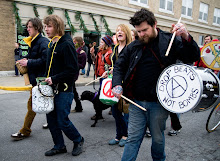
Angela is not in any of the pictures because she is behind the camera. Here is a video someone shot of the day. Notice Whitman at around 2:28. He was a real hit, no pun intended, when he banged the circle A drum.

Saturday, March 15, 2008

My Leftist Hand


This is on my left hand. It is the logo of sticks&stones. If you are curious, it is a Palestinian boy launching a rock with a wrist-rocket at an oncoming Israeli tank. Yep, I smash the state, one tattoo at a time!

Wednesday, March 12, 2008

Still A Fucking War!


Well, we are approaching the 5 year birthday of certain death for millions of people. Of course I mean the war of occupation on Iraq. At this point, we have been in Iraq longer than WWI, WWII, and the Vietnam War combined. Let us not forget that we were there during Bush I in the Gulf War, a war which has had a surmounting level of casualties still today, considering the amount of chemical warfare used by and against our own troops by the U.S. Government. It is not known the level of devistation caused by that war, and following that, the hardship was continued by U.S. backed economic sanctions since 1990 whose limitations were strengthened by the left's favorite dope smoking president, Bill Clinton. Here is a little article I found that describes in a very short manner, the economic war on the civilians of Iraq.

Sanctions Against Iraq

The UN Security Council imposed comprehensive economic sanctions against Iraq on August 6, 1990, just after the Iraqi invasion of Kuwait. When the coalition war had ousted Iraq from Kuwait the following year, the Council did not lift the sanctions, keeping them in place as leverage to press for Iraqi disarmament and other goals. The sanctions remained in place thereafter, despite a harsh impact on innocent Iraqi civilians and an evident lack of pressure on Iraqi leader Saddam Hussein. A UN "Oil-for-Food Programme," started in late 1997, offered some relief to Iraqis, but the humanitarian crisis continued. The US and UK governments always made it clear that they would block any lifting or serious reforming of sanctions as long as Hussein remained in power. After more than twelve years of sanctions had passed, the US and the UK made war on Iraq again in March, 2003, sweeping away Hussein's government. Soon after, Washington called for and obtained the lifting of sanctions, a step that gave the US occupation authority full control over Iraq's oil sales and oil industry.


Now keep mind that, much like the U.S., Iraq's tyrant, Sadam, was extremely wealthy, there-by going largely unaffected by economic strangulation of the country by the Oil loving world. The ones to suffer from these sanctions, of course, was the middle and lower class citizens of Iraq. It is estimated that 1 million Iraqi's died due directly to sanctions, the largest part of them being children. This is a slow genocide on the people of Iraq, being acted out on future generations. The number of children poisoned by chemical food and water is unknown, not because it is not happening, but because the numbers are so high, no one specific group has been able to calculate the numbers across the board, and rapidly they are moving from the injured list to the dead list.

I want you to take notice of what happened after the fall of the Iraqi government in this most recent war. All sanctions were lifted and the U.S. is now in control over the rights of the economic trade in Iraq. This is nearly the definition of Imperialism, to overthrow one's existing government by outside military force, installing one's own control structure, and seizing the assets and resources of a land for personal profit, this is an empire at work.

The reason for this short post on a much larger subject to raise awareness that on March 16th, there will be many peace marches all over the world to voice our disgust with this oil war. The last war protest in the US of any substantial support, was on the eve of the invasion in 2003. It seems now, five years later, that people have forgotten what is means to be in a democracy. We place bumper stickers on our car and profess our love of certain candidates, but have stopped voicing our defiance against the largest moneymaker in US history...murder.

This March, join together with neighbors and friends, loved ones and political enemies to stand side by side in defiance of the war machine. The war in Vietnam played out the opposite of this war, in that it started with a large amount of support of the citizens of the US, and ended due in part to those citizens turning the coin to see how un-shiney war really is, and taking to the streets against it. This war had a large population of detractors in the days leading up to it, followed by an eerie silence in the years since. This election year, let's remind them who is working for who and take it out of the voting polls and coffee shops to the streets in glorious dissent. Contact me for information on marches in your area, or google peace movement and get involved, if there is not currently a march in your area, plan one. This war must end somehow, and who better than us to stop it, and what better time than today?


Tuesday, March 4, 2008

The great debate.

Okay, so this may not be the great debate, as I really don't feel I represented myself too clearly. But hey, it was ayami ha and I spent the morning discussing the role of a spiritual being as a dissenter in the face of oppression, specifically concerning the Baha'i faith and their role of non-participation in politics surrounding the Israeli occupation of Palestine. I was intellectually wiped out for the day. I made some arguments that I don't feel I gave proper context for, but such is life.

Here is the discussion, held with myself, Janet Shahn of www.blackpoliticalthought.blogspot.com, Mitch Berg, conservative talk radio host, and the militant moderate middle musher, Marty Owings.


Also, tonight I was in Columbia, MO to interview Norman Finkelstein, which I did, and was pleased. I also ran into some cats of the highest caliber, calling themselves the Mischievous Gnome Collective. I interviewed them as well and will be posting both in the near future.